
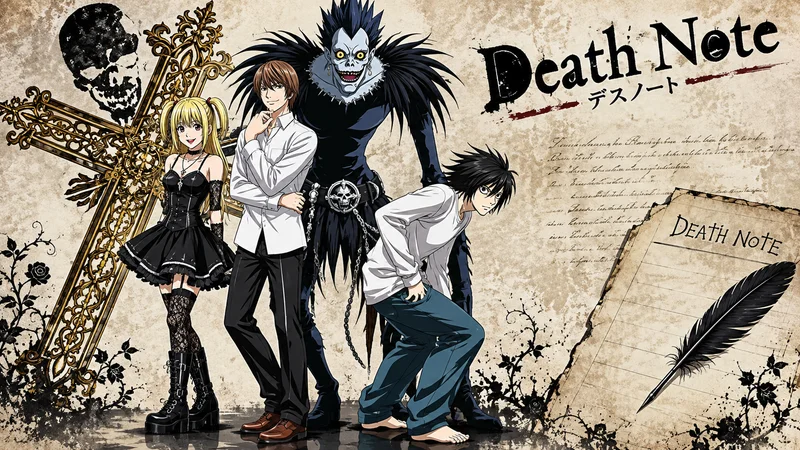
When did Death Note come out? The original manga began its regular run in Japan on December 1, 2003, in Weekly Shonen Jump. The anime premiered on October 3, 2006, and the first Japanese live-action movie reached theaters on June 17, 2006. These dates refer to different versions of the same story, not competing answers about a single release.
Written by Tsugumi Ohba and illustrated by Takeshi Obata, Death Note follows Light Yagami, a student who discovers a notebook that can kill people whose names are written inside it. Its mixture of supernatural mystery, psychological suspense, and moral conflict makes it a distinctive choice among the many manga genres readers can explore through MangaNato.
The story reached readers in print before it became widely known through animation and film. This article explains the manga’s first publication, the dates of its Japanese and English collected volumes, the anime’s broadcast, and the main movie releases. It also clarifies why 2003, 2004, 2006, and 2007 all appear in discussions of Death Note’s history.
When Did Death Note Come Out as a Manga?
Death Note’s regular serialization started on December 1, 2003, in Shueisha’s Weekly Shonen Jump. The opening chapter introduces Light and the supernatural rules that make the notebook so dangerous. His decision to use it against criminals soon attracts the attention of the detective L, establishing the contest of intelligence at the heart of the series.
The manga ran until May 15, 2006, with 108 chapters collected into 12 main volumes. That complete original storyline is the starting point for the anime and several adaptations. A separate pilot chapter had appeared earlier in 2003, but it was not the first installment of the regular series featuring Light’s full story.
The distinction matters because an initial experiment, a weekly debut, and a collected book can have different dates. For the manga that developed into the familiar Light-versus-L narrative, December 1, 2003, is the key starting date.
Why the Year 2004 Appears in Release Records
The magazine issue carrying the first regular chapter was labeled as the first issue of Weekly Shonen Jump’s 2004 cycle, even though it went on sale in December 2003. An issue’s printed year is not necessarily its actual publication day. That explains much of the apparent disagreement between 2003 and 2004.
A second source of confusion is the difference between serialization and collected volumes. The major early milestones were:
- December 1, 2003: The regular manga began appearing in Weekly Shonen Jump.
- April 2, 2004: Shueisha released the first collected volume in Japan.
- October 10, 2005: VIZ Media released Volume 1 in English.
- May 15, 2006: The original weekly manga serialization ended.
All four dates are meaningful, but they describe different stages of publication. The most precise answer depends on whether someone is asking about a magazine chapter, a Japanese book, or an English-language edition.
When Did Death Note Come Out in Book Form?
The first Japanese collected volume was published on April 2, 2004. It gathered the opening installments into a standalone book, giving readers a way to follow Light’s early decisions and the investigation without collecting individual magazine issues.
The first English-language volume followed on October 10, 2005, through VIZ Media. This is an important date for English-speaking manga readers, but it should not replace the 2003 debut when describing the original series. Translation and distribution take place on different schedules from Japanese publication.
The main story fills 12 volumes. Death Note 13: How to Read is a companion publication with background and supplementary information, not a thirteenth volume extending the central narrative. Later editions and compilations likewise do not change the date of the original debut.
When Did Death Note Come Out as an Anime?
The Death Note television anime premiered in Japan on October 3, 2006, and its original broadcast ended on June 26, 2007. Madhouse produced the 37-episode adaptation, directed by Tetsuro Araki. The manga’s main story had already concluded when the first episode aired.
Animation gave the series another way to build suspense. Voice performances, music, editing, and carefully timed reactions turn Light and L’s strategic conversations into tense television scenes. However, 37 episodes cannot reproduce every moment of a 108-chapter manga, so some details receive a shorter treatment.
To keep the broadcast dates distinct from the manga’s publication, remember these points:
- 2003: The manga began its regular Japanese serialization.
- October 2006: The first anime episode aired on Japanese television.
- June 2007: The 37-episode television run concluded.
Later international broadcasts, dubbed releases, and streaming availability followed their own schedules. The October 2006 date refers to the original Japanese premiere rather than the first time every country could watch it.
What Changes Between the Manga and the Anime?

Both versions center on Light’s use of the notebook and the efforts to expose Kira, the name associated with the unexplained deaths. Their fundamental conflicts are the same, but scenes differ in pacing, emphasis, and occasionally in how an ending is presented. Reading the manga can provide additional investigative detail that the anime condenses.
Misa Amane’s later circumstances demonstrate why the distinction matters. Does Misa die in Death Note? The anime’s final imagery leaves some elements less explicit, while the manga’s supplementary material gives readers further context. Treating both versions as identical can lead to a misleadingly certain interpretation.
These differences do not require choosing one format as the only valid way to experience the story. The manga preserves its original panel-by-panel reasoning, whereas the anime creates tension through movement and sound. Each is worth evaluating on its own terms, especially when discussing character outcomes.
When Did Death Note Come Out in Movie Theaters?
The first Japanese live-action Death Note film opened on June 17, 2006, several months before the television anime debuted. Directed by Shusuke Kaneko, it starred Tatsuya Fujiwara as Light and Kenichi Matsuyama as L. The second film, Death Note: The Last Name, followed on November 3, 2006.
The film series continued to develop beyond those first two releases. Important movie milestones include:
- June 17, 2006: Death Note, the first Japanese live-action film.
- November 3, 2006: Death Note: The Last Name, its Japanese follow-up.
- February 9, 2008: L: Change the World, a film centered on L.
- October 29, 2016: Death Note: Light Up the New World, a later Japanese film.
- August 25, 2017: Netflix released its American live-action adaptation.
These films draw on the original premise but do not all follow the manga scene for scene. In particular, the 2017 film reimagines the setting and characters. None of the movie dates changes the fact that Death Note began as a manga in 2003.
Why the Manga Ended in 2006 but the Anime Ended in 2007
The manga’s regular serialization finished on May 15, 2006, whereas the anime broadcast its final episode on June 26, 2007. The difference is straightforward: a completed manga was adapted for television on a separate production and broadcasting schedule.
Later books and short stories can make the franchise’s history look longer than its original storyline. VIZ Media released Death Note Short Stories in English on May 10, 2022, collecting material such as the pilot chapter and later stories about the notebook’s influence. These additions expand the setting without reopening the 108-chapter central manga run.
It therefore helps to separate three questions: when a story started, when its original run ended, and when related material was released afterward. Mixing those dates together creates confusion about whether the core manga remains ongoing.
Should You Read the Manga or Watch the Anime First?
Start with the manga if you enjoy close attention to dialogue, clues, and characters’ reasoning. Its collected volumes let you control the pace of a mystery in which a seemingly minor decision can change the entire investigation.
Choose the anime if voice acting, music, and dramatic pacing are more appealing. Its 37 episodes tell a complete adaptation of the main conflict, so no movie is required beforehand. Watching it after reading the manga can also reveal what changed between formats.
The live-action films work best as alternate interpretations rather than essential steps between the manga and anime. Regardless of where you begin, knowing the release order helps you avoid confusing a film-specific scene with something established in the original manga.
Frequently Asked Questions
When did Death Note come out in English?
VIZ Media released the first English-language manga volume on October 10, 2005. This date refers to the English collected edition, not the start of the original Japanese magazine serialization.
When did Death Note come out on Netflix?
The American live-action Death Note film premiered on Netflix on August 25, 2017. It is a later adaptation, not the first release of the manga or anime.
When did Death Note come out as a pilot story?
A separate Death Note pilot chapter appeared in Weekly Shonen Jump in 2003 before the regular Light Yagami series began that December. The pilot should not be confused with Chapter 1 of the main storyline.
Is the original Death Note manga still ongoing?
No. The main manga concluded in May 2006 and comprises 108 chapters across 12 collected volumes. Additional short stories and companion books exist, but they are separate from the original weekly run.
Conclusion
When did Death Note come out? For the original manga, the answer is December 1, 2003. The first Japanese collected volume appeared on April 2, 2004, the anime premiered on October 3, 2006, and the first Japanese live-action film opened on June 17, 2006.
Each date belongs to a specific format. Keeping the manga, anime, and films separate makes the release history clear and helps readers understand which version they are discussing.

ZipZapZia is a content contributor at MangaNato with a passion for manga, manhwa, and manhua. Focusing on unique stories, emerging trends, and diverse genres, ZipZapZia helps readers discover exciting titles and fresh reading experiences.